
Hantavirus Dreaming
Disaster Wishcasting and the Death Urge of Apocalyptic Absolution

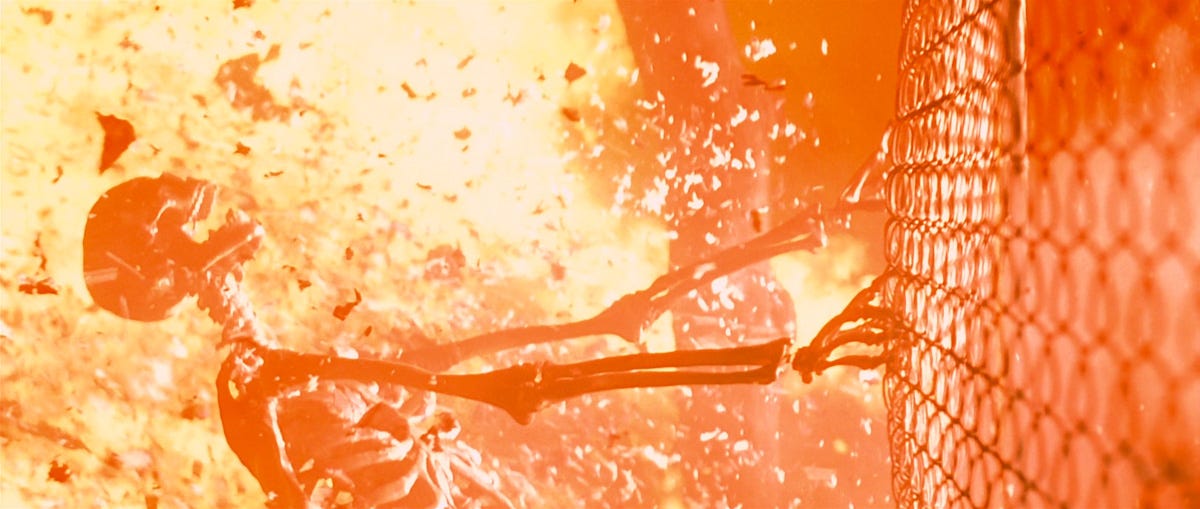
“So this is the world. Can you see… Can you see what you have made? How do you stand the disappointment?”
Jonathan Hickman, Ultimates
It has become apparent to me that some of you are not joking when composing posts about the Hantavirus Cruise Ship inevitably dooming us all to another global pandemic. I get the sense that some of you do not think this would be a bad thing.
For the mercifully uninitiated; aboard the three-hundred and fifty foot cruise ship MV Hondius, owned and operated by the Dutch firm Oceanwide Expeditions, nine passengers have thus far been either confirmed or deemed to have probably contracted the Andean hantavirus, most commonly found in rodents. Three people have died. A few dozen more are under observation by state or international public health authorities. It is a tragedy. People have died. But in the hyperinflated schadenfreude industrial complex of the Internet, there is virtually no action which some people will not view as goading the grim reaper into action, therefore making it justifiable and even, perhaps, morally courageous to mock a stranger’s untimely demise for clout.
In another world this is what you would hear while cornered by the worst guy at the office party. Coworker stuff. The sort of pop-conspiracy indulged in by people living unexamined lives and arriving late to every item of inquiry, certain that they can glean all the answers from a half hour on their feed of choice. The sort of people who parse all our current events through the motivations of some nebulous “they” and what “they” “want us to think.”
We don’t live in that other world and so the feeling is something altogether more tragic.
In some cases, the rapt attention paid to every new datum about the Hantavirus Outbreak recalls footage of punch-drunk boxers snapping back to momentary lucidity, hands at the ready, when a bell sounds. The traumas of the COVID-19 pandemic, bundled up and submerged as quick as we could manage, have resurfaced. If you feel that March 2020 anxiety cropping back up, if you find yourself glued to your phone or your preferred cable news channel, I do not think less of you for it.
I have survivor’s guilt about the COVID era because it was good for me. Pre-COVID I was an underemployed recent college graduate, a part time barista turned part time pizza chef, smoking too much weed, drinking too much, not writing enough despite delusions that I’d soon sell a novel and graduate to a life of cosmopolitan splendor. I didn’t really want a job and didn’t really want to write and didn’t really want to change. COVID left me no other option besides change.
That was five and a half years ago. My girlfriend in 2020 is now my fiancée in 2026. We’ll marry in October. I work a full time job with benefits. I’ve sold stories and essays and found peers, friends, readers as a writer. Life is good. But guilt abounds in our own happy home and in all the others thanking their lucky stars. I was lucky. Many others were not. The COVID era was a reaping. Families driven apart. Dreams deferred. This is, of course, to say nothing of the dead, so conveniently forgotten as COVID shifts in the collective unconscious from the crisis of a generation to a typical overreaction of a coddled society. No big deal, really.
There is a sense of missed opportunity. In our rush back to normalcy we mourned nothing but the free time lost. The social rot which we intellectualized and monetized and polemicized burst forth into our public space like the rotten guts popping out of a decaying beached whale, in a geyser of offal and noxious gasses and we’ve spent the half decade since posing with the rotten guts draped over ourselves like luxurious furs, composing pithy little witticisms about how fucked we all are.
We blew it and we know we blew it and we’re begging for a second chance. Our social sphere is reduced to a macro scale midnight text to the girl we never should have dumped, an arrival at our old office unannounced to beg for our old job back, a deniably-ironic wish for another global pandemic, a more severe one, one that will blow away the old world and absolve its sins.
That’s the word, I think, “absolution.” We want absolution without having to pay penance. We’re flagellants that don’t want blood on our clothes or scars on our backs. The unpleasantness of changing the world in a lasting sense cuts into our TV time. Writing off your country, your species, your world, is simpler and easier than fighting for any or all of them. We know we are sinners and crave the wrath of God to bleach us away but do not want to be seen calling for it. All of this discourse must be parsed through layers upon layers of detachment and insulation. It is a kind of ecstatic performance of nihilism wherein the residents of the world’s richest countries cheer to hasten the death of the system which insulates them from all consequence. A world where children fantasize about the day they’ll feel the kiss of the nuclear blast wave. It is an ideology of self-satisfied cowardice, performed as kabuki theatre through layers upon layers of gilded irony, so that it may never confront its true loathsomeness. Under this framework, no world at all is preferable to a better world because a better world may ask something of you. The basic tenets of this belief system are that everything was better at some point in the past, it’s all been terrible since, it’ll never get better, and you’re a rube for believing otherwise. Any attempt by the individual to prosper or cultivate some personal talent is taken as proof of their unworthiness, naivete, or miscalibrated priorities. The successful are industry plants. The fulfilled are performative. The happy are disrespecting victims with their smiles or hiding atrocity behind them.
The result is a kind of Calvinism with no God and no elect. It believes the world is fallen and man is inherently evil but no redemption can take place. Nobody can ever become worthy of forgiveness because if they were, they wouldn’t have erred in the first place. It’s a realm of Marxist-coded posturing where the ability of the state to do anything beyond oppressing the weak and harming the blameless is considered the stuff of fairy tales, beyond the cynicism of any Libertarian. It terminates, inevitably, in the conception of the apocalypse as the ultimate absolution. No more office, no more commute, no more busywork and chores, no more complicated feelings or interactions, just one last hit of schadenfreude before we are engulfed, still riding the high. Zizek compared our disaster fixation to our sex drive, deeming us “perverts who are secretly horny for the apocalypse.” I would argue it’s more a millenarian urge than a libidinal one.
We are tired of death by tenths of a percentage point, we are bored of incrementalism, the band-aid being ripped off all at once would at least be exciting for a day or two. It would at the very least remove the contradiction of modern information consumption, the sense that something must be done immediately and the equal and opposite sense that nothing can possibly be done. The desire isn’t so much the orgasmic catastrophe of Zizek’s Hollywood gasoline explosions tearing through collapsing skyscrapers but a more quiet kind of surrender. A society infantilized, relieved of the burdens of agency, returned to the cradle, to the womb, is a society gone extinct, or at least decimated.
All of this is the damage of the COVID years, a time in which so many found their futures rendered inert and gave birth to a broad consensus that the future itself was inert, illusory, dead. Do not allow yourself to hate the people who fall into this sort of thinking. Pity them. Avoid them if you feel it’s healthy. But you cannot hate them. Other people are all we have. True, the world can be exhausting, the long struggle can be cruel, the work can come to no profitable end, but the attempt itself is virtuous. Today’s failure is tomorrow’s trailblazer.
We will be parsing and unfurling the residual damage of COVID for years to come. In that time, healing will take place. There will come a day when the adolescent now dreaming of a Hantavirus lockdown wakes up and realizes they spent the best years of their lives dreaming of death. In the midst of the crisis which inevitably ensues in the wake of such a realization, it behooves us, as people still in the fight, to make space in the line, offer a salute to our returned comrade, and say “we’ve been waiting for you, glad you could join us.”
I really relate to feeling weird about lockdown because my own personal lifestyle was pretty well adapted to what it required. 15 years old, living with my parents, dad became WFH for a major national grocery store chain, primary hobbies included videogames and reading. I was procrastinating really hard on a bunch of major projects in school that evaporated. It took a few months for the Pandemic to really hit me as something that actually made my life worse.
I enjoyed this. Do you remember all of the people prior to the pandemic that would post things like “A plague would be great!” and then they got one and they were freaking out. Stop wishing for the things you don’t want. Life isn’t that bad. Enjoy it. Do meaningful things.